
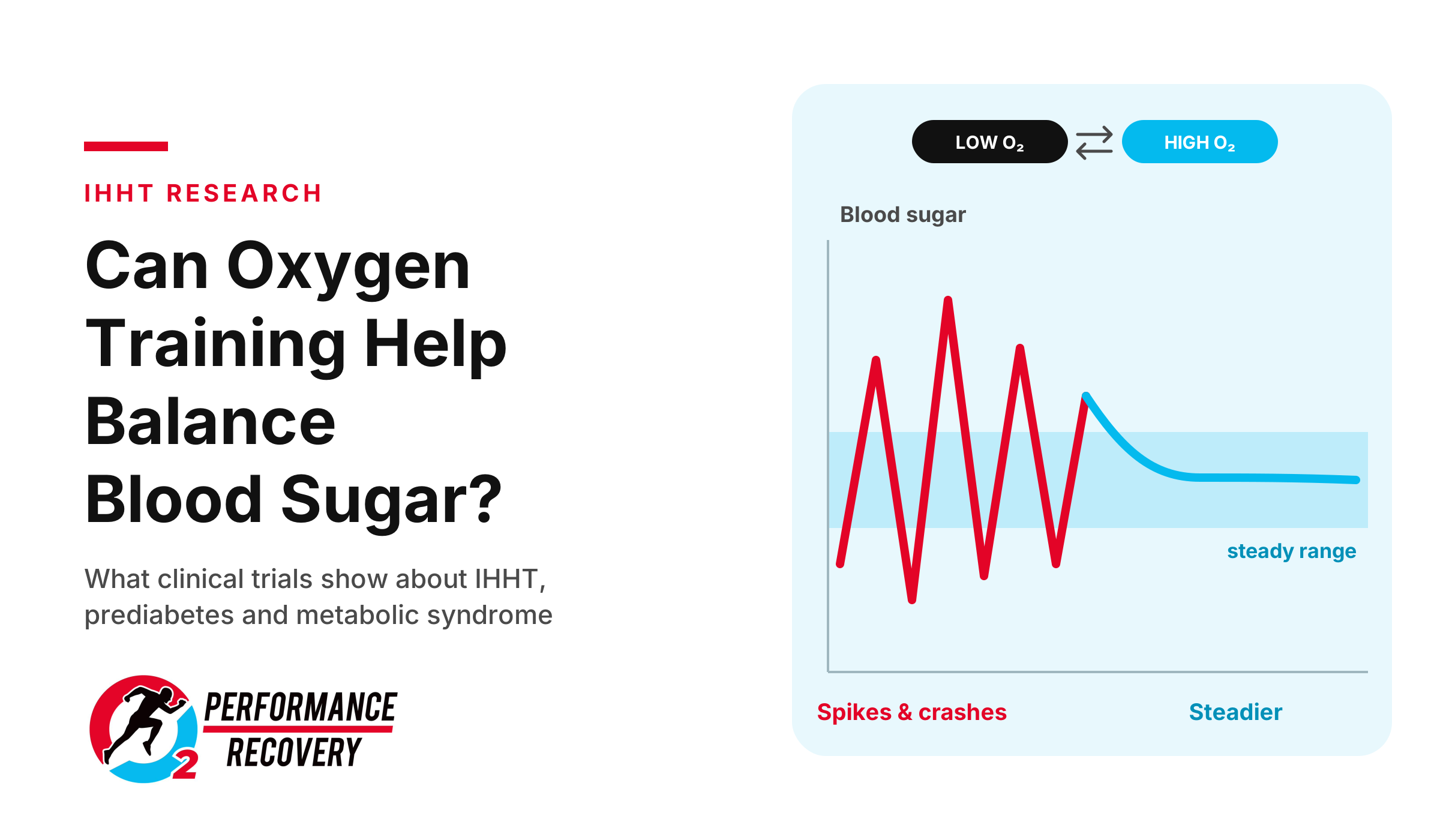
Can Oxygen Training Help Balance Blood Sugar? What the Research Says About IHHT and Metabolic Syndrome

Your doctor used the word “borderline.” Maybe it was your fasting glucose. Maybe your A1C report is up a few points, your waistline followed, and your blood pressure started reading a little higher every visit. Nobody called it a disease. But nobody told you how to turn it around, either.
If that sounds familiar, this post is for you. It is also for anyone who has been told to “exercise more” and finds that hard right now because of joint pain, fatigue, or a schedule that leaves no room.
Here is the short version. A small but growing body of clinical research shows that intermittent hypoxic-hyperoxic training (IHHT), the oxygen training we do at O2 Performance and Recovery, can improve markers tied to blood sugar and metabolic health. The studies are real, they are randomized and placebo-controlled, and they are also small. Below we walk through exactly what they found, what they did not find, and how IHHT fits alongside the basics.
What metabolic syndrome actually is.
Metabolic syndrome is not one condition. It is a cluster of warning signs that tend to show up together:
*Extra weight carried around the middle
*Blood sugar that runs higher than it should (prediabetes or insulin resistance)
*Higher blood pressure
*Higher triglycerides and LDL cholesterol, lower HDL
Having three or more of these puts you in the metabolic syndrome category. People in this group are about three times more likely to develop heart disease than people without it, and they are on the road toward type 2 diabetes.
The good news is that this cluster is often reversible when it is caught early. That is exactly why researchers have been looking for tools that help the body handle sugar and fat better, especially for people who struggle to exercise hard enough to get those benefits on their own.
Why oxygen and blood sugar are connected.
It seems strange at first. What does breathing have to do with sugar? Quite a lot, it turns out.
Low oxygen opens a second door for sugar. Normally, insulin is the key that lets sugar leave your blood and enter your muscles. In insulin resistance, that key stops working well. But muscles have a second door. When they sense low oxygen, they switch on an energy sensor called AMPK, which pulls sugar into the cell without needing insulin. It is the same pathway exercise uses. Researchers at the University of Texas describe it exactly this way in their registered trial on intermittent hypoxia and glucose.
Your body learns from the stress. Brief, controlled drops in oxygen activate a master switch called HIF-1 alpha. It turns on genes for insulin receptors and glucose transporters, the machinery that moves sugar into cells. In one of the trials below, the people whose HIF-1 alpha rose the most were the same people whose blood sugar improved the most.
The oxygen-rich phase helps you recover faster. In IHHT, each low-oxygen interval is followed by enriched oxygen instead of plain room air. The goal is a quicker reset between rounds, so the session delivers the same signal in less time.
If you have read Why Your Cells Get Tired, this is the same story from a different angle. Mitochondria burn sugar and fat for fuel. When they work better, your body has an easier time keeping blood sugar steady.
What the clinical trials show
Four lines of human research are worth knowing. Every one used a control or placebo group, which means researchers compared real oxygen training against a fake version so they could tell what actually made the difference.
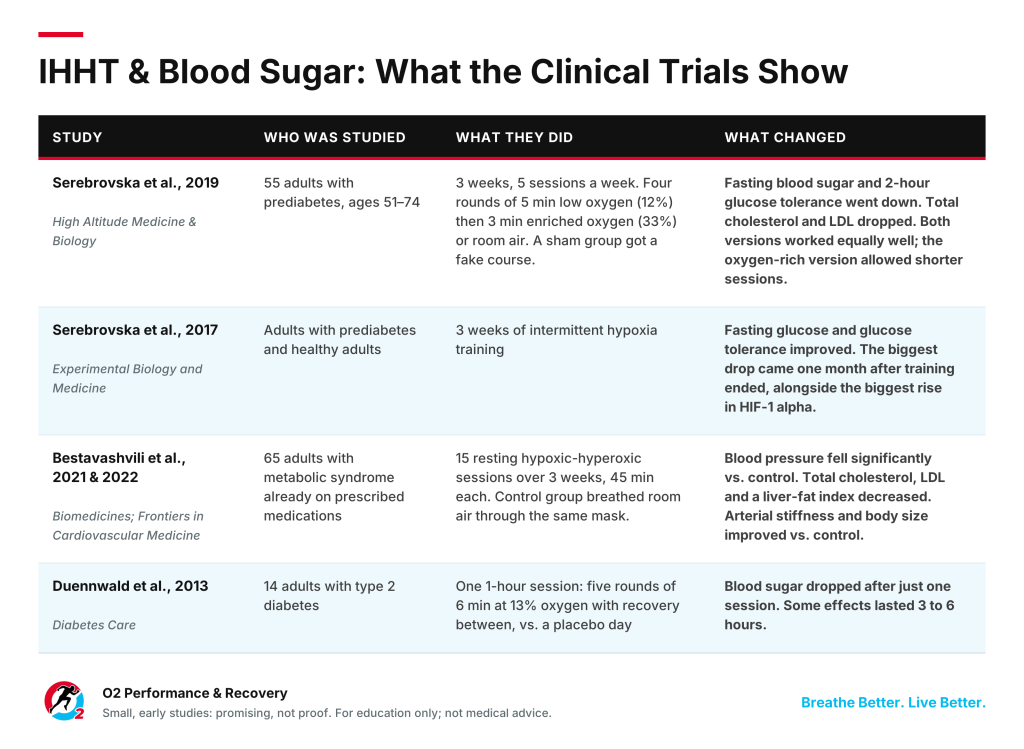
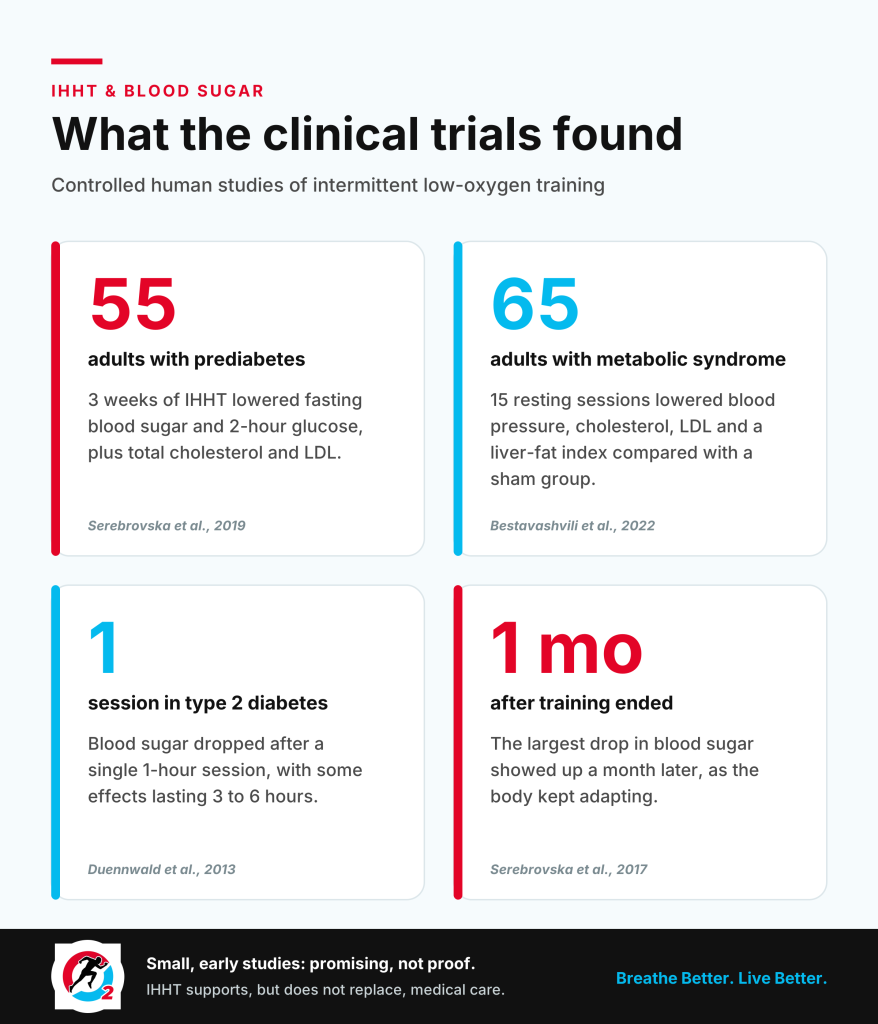
Three things stand out.
1. Blood sugar moved in the right direction in the prediabetes trials, both fasting and after a sugar drink.
2. The benefits extended past sugar. In people with metabolic syndrome, blood pressure, cholesterol and liver fat improved too, and this was on top of their regular medication.
3. The effect may build after training ends. In the 2017 trial, results were strongest a month later. That fits the idea that the body is adapting, not just reacting.
Notice also that participants in the metabolic syndrome trial did their sessions at rest. For anyone who finds hard exercise difficult right now, that matters.
What the research does not show yet.
We promised on our blog page to tell you what the research says and what it doesn’t say yet. So here is the other half.
• The trials are small. The largest had 65 people. Results this consistent are encouraging, but bigger trials are needed before anyone calls this proven.
• Most programs were short. Three weeks is a long way from years of better blood sugar. We do not yet know how long the benefits last without maintenance sessions.
• Oxygen-rich vs. room-air recovery is still debated. A 2022 systematic review in Sports Medicine – Open found no strong evidence yet that adding enriched oxygen beats ordinary room air for health outcomes. The low-oxygen intervals appear to do the heavy lifting.
• Dose matters. The low oxygen in these studies is brief, measured and supervised. That is very different from untreated sleep apnea, where oxygen drops all night long and blood sugar control tends to get worse, not better.
• IHHT is not a diabetes treatment. None of these studies replaced medication, diet or movement.
Where IHHT fits in your plan.
Think of IHHT as one tool working alongside the foundations, not instead of them. Food, sleep, movement and your doctor’s care still matter most. IHHT can make the work your body is already doing a little more efficient.
What a session looks like at O2. You sit in our reclining chair or pedal lightly on a stationary bike, wearing a mask. Pedaling is encouraged if you are able, because it tends to bring quicker results, but it is not required. Over 20 to 30 minutes, the air shifts between reduced oxygen and enriched oxygen for several rounds. A certified coach is with you the whole time, watching your oxygen levels and adjusting the session to you. We also teach Oxygen Advantage breathing techniques during every session.
How often. For metabolic goals, our usual plan is 2 to 3 sessions a week to start, with about 16 to 20 sessions over three months, then a weekly maintenance session. That mirrors the frequency used in the trials above.
Pair it with nutrition. Blood sugar is shaped by what is on your plate. Our 3-month Functional Health Coaching program helps you build eating habits that work with your training instead of against it.
If you take medication for blood sugar, read this. Several studies saw blood sugar drop after sessions, and the type 2 diabetes study saw it after a single one. If you use insulin or medicines that lower blood sugar, talk with your doctor before you start. Check your glucose before and after your first few sessions, and bring a snack. Tell your coach about any medications at your intake so we can plan around them.
Frequently asked questions
Can IHHT lower my blood sugar? In controlled trials of people with prediabetes, a 3-week course lowered fasting blood sugar and improved glucose tolerance. In people with type 2 diabetes, one session lowered blood sugar for several hours. Results vary from person to person.
Can IHHT reverse metabolic syndrome? No study has shown that. In one randomized trial, adults with metabolic syndrome saw lower blood pressure, cholesterol and liver fat after 15 sessions. Reversing the syndrome takes a full plan, and IHHT can be part of it.
Do I have to exercise during a session? No. The metabolic syndrome trial used sessions at rest. Light pedaling is encouraged if you can, but you can recline the whole time.
How soon would I notice a change? Many clients feel more energy within 3 to 7 sessions. Lab changes like glucose and cholesterol take longer, and in one trial they were strongest a month after training ended.
Is it safe if I take diabetes medication? Talk with your doctor first. Because blood sugar can drop after sessions, your medication may need watching.
Isn’t low oxygen bad for blood sugar? I heard that about sleep apnea. All-night, uncontrolled drops in oxygen, as in untreated sleep apnea, are linked to worse blood sugar. IHHT uses short, measured, supervised intervals with recovery in between. Dose and control make the difference.
Ready to see where you stand?
If your numbers are drifting and you want a tool that works with your body, not against your schedule, start with a conversation. Bring your latest labs if you have them. We will walk you through a session, answer your questions, and help you decide whether IHHT fits your goals.
Black Friday, our biggest sale of the year, runs through November 29. New and returning clients get 25% off the first month of any monthly package, and returning clients also get a free session and progress reassessment when they sign up. Demo sessions are free all November. (Excludes 3-month plans.)

Book your intro session or call or text us at 404-759-6604. You can also visit us at 1021 Jamestown Blvd, Suite 215, Watkinsville, GA.
Breathe Better. Live Better.
Disclaimer: O2 Performance & Recovery services and information are intended for general educational and wellness purposes only and are not a substitute for medical diagnosis, treatment, or professional healthcare advice. Individual results may vary. Consult a qualified healthcare professional before beginning any new exercise, recovery, nutrition, or wellness program—especially if you have a medical condition, are pregnant, take medication, or have an injury.
References
References
1. Serebrovska TV, Grib ON, Portnichenko VI, Serebrovska ZO, Egorov E, Shatylo VB. Intermittent hypoxia/hyperoxia versus intermittent hypoxia/normoxia: comparative study in prediabetes. High Altitude Medicine & Biology. 2019;20(4):383–391.
2. Serebrovska TV, Portnychenko AG, Drevytska TI, et al. Intermittent hypoxia training in prediabetes patients: beneficial effects on glucose homeostasis, hypoxia tolerance and gene expression. Experimental Biology and Medicine. 2017;242(15):1542–1552.
3. Bestavashvili A, Glazachev O, Bestavashvili A, et al. Intermittent hypoxic-hyperoxic exposures effects in patients with metabolic syndrome: correction of cardiovascular and metabolic profile. Biomedicines. 2022;10(3):566.
4 Bestavashvili AA, Glazachev OS, et al. The effects of intermittent hypoxic–hyperoxic exposures on lipid profile and inflammation in patients with metabolic syndrome. Frontiers in Cardiovascular Medicine. 2021;8:700826.
5. Duennwald T, Gatterer H, Groop PH, Burtscher M, Bernardi L. Effects of a single bout of interval hypoxia on cardiorespiratory control and blood glucose in patients with type 2 diabetes. Diabetes Care. 2013;36(8):2183–2189.
6. Behrendt T, et al. Effects of intermittent hypoxia–hyperoxia on performance- and health-related outcomes in humans: a systematic review. Sports Medicine – Open. 2022;8:70.
7. University of Texas System. Influence of intermittent hypoxia on glycemic control (NCT06490900). ClinicalTrials.gov.