


You are not lazy. You know that, even on the days you wonder about it.
The tiredness you carry is not the kind a Saturday nap fixes. Coffee takes the edge off for an hour. You sleep eight hours and wake up already behind. Maybe you have had your bloodwork done and been told everything looks fine, which we wrote about in Tired All the Time but Your Bloodwork Is Normal?
If that sounds familiar, it is worth understanding what happens at the smallest level of your body, where energy is actually made. That story starts with mitochondria.
The short answer. Mitochondria are tiny structures inside nearly every cell that turn the oxygen you breathe and the food you eat into ATP, the fuel your body runs on. When there are fewer of them, or they work less efficiently, your cells have less fuel to spend. Your body can build new mitochondria and clear out worn ones, and it does both in response to demand.
What are mitochondria?
Mitochondria are the energy makers inside your cells. They take the oxygen from every breath and the food from every meal and convert them into ATP, which is the fuel that runs everything you do, from climbing stairs to remembering a name.
Think of every cell in your body as a house, and mitochondria as the furnace. A house with a strong furnace stays warm without effort. A house with an old, sputtering furnace is always a little cold, no matter how much fuel you buy.
Your muscles, heart and brain use enormous amounts of energy, so they are packed with mitochondria. When those furnaces slow down, those are often the places you feel it first.
Why do mitochondria slow down?
As we age, the body gets slower at clearing out worn mitochondria and building new ones. Damaged ones stay in service longer than they should, and fewer fresh ones replace them. Scientists describe this as a decline in mitochondrial “quality control,” and it is one of the most studied parts of how the body ages.
A simple way to picture it: a cell full of tired mitochondria is a bit like a crew of couch potatoes. They still show up. They just do not get much done.
A 2014 review of mitochondrial aging, published in BioMed Research International, noted that when researchers accounted for how active people were, many studies did not find a clear link between age alone and how well mitochondria worked. In other words, some of what we blame on birthdays may have more to do with how much we move. The research is still developing, but that is a meaningful possibility.
Can you build new mitochondria?
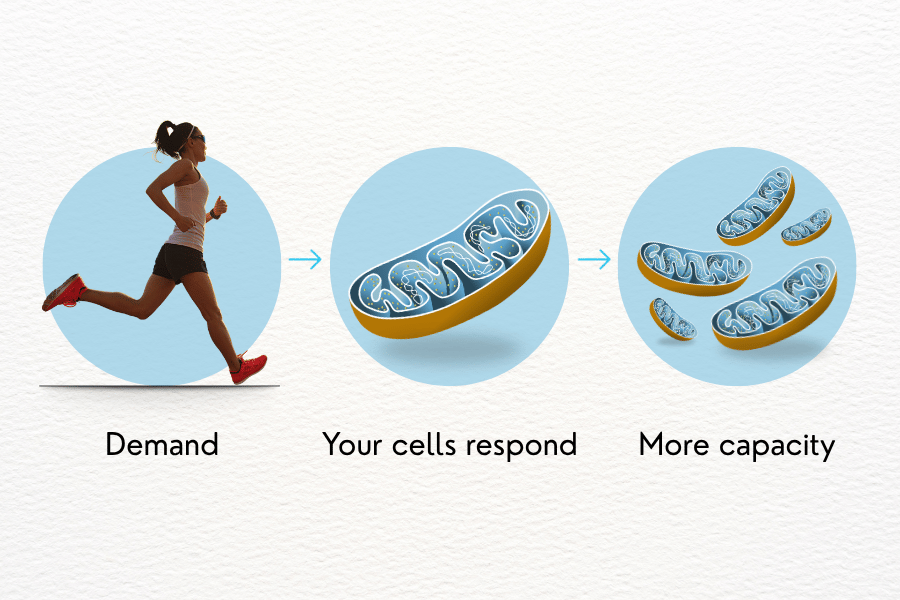
Yes. Your body makes new mitochondria through a process called mitochondrial biogenesis, and the main thing that switches it on is demand. When your cells are asked to produce more energy than usual, they respond by building more capacity.
A review titled Regulation of Mitochondrial Biogenesis describes early comparisons between birds. Chickens, which rarely fly, have fewer mitochondria in their breast muscles than pigeons, which fly long distances. Your heart, which never stops working, carries more mitochondrial activity than muscles that only work now and then. The pattern is the same everywhere researchers have looked: tissue that is asked to work regularly builds the equipment to do it.
Exercise research points the same way. A review in the journal Oxidative Medicine and Cellular Longevity describes how exercise appears to do two things at once: increase the number of mitochondria and help the body remove the damaged ones.
What does oxygen have to do with it?
Oxygen is what mitochondria use to make energy, and your cells have a built-in system for sensing how much of it is available. When oxygen runs low, cells switch on genes that help them adapt.
That system was important enough to win the 2019 Nobel Prize in Physiology or Medicine. William Kaelin Jr., Sir Peter Ratcliffe and Gregg Semenza were recognized for discovering how cells sense and adapt to changes in oxygen. The prize was not awarded for IHHT or for any training method. It explained the biology that methods like ours are built on: when oxygen shifts, the body notices, and it adjusts.
Where IHHT fits in
IHHT stands for Intermittent Hypoxic Hyperoxic Training. The easiest way to describe it is elevation training without all the gear, travel, and the mountains.
Athletes have trained at altitude for generations because thinner air asks more of the body. IHHT borrows that idea in a controlled setting. We gently lower the oxygen you breathe, then raise it well above normal, and repeat that a few times over about 20–30 minutes.
The low-oxygen stretch creates demand. The high-oxygen stretch delivers what the body is now asking for. Most clients ride a stationary bike at an easy pace during a session, because light movement adds to that demand. It is gentle, guided and short. It is not passive, and it is not meant to wear you out.
We do not do this to you. We give your body the oxygen and energy it has been short on and let it respond the way it is built to respond.
Research on intermittent hypoxic and hyperoxic training is still young. A 2019 randomized controlled trial in BMC Geriatrics tested adding it to a training program for adults aged 64 to 92. A 2026 randomized trial in the journal Sports followed 22 older adults over six weeks and found that a measure of breathing muscle strength improved in the group that trained, with no change in the comparison group. Twenty-two people is a small study, and those researchers’ methods are not identical to ours. The field as a whole, including the 2024 textbook Hypoxic Conditioning in Health, Exercise and Sport, is clear that larger trials are still needed. That is what honest, developing science looks like.
What you can do this week, with or without us
Supporting your mitochondria does not start with us. It starts with demand, and much of that is in your hands.
- Move a little, every day. Regular movement is the most studied signal for building new mitochondria. A walk counts. If fatigue is new or severe, talk with your doctor before changing your activity.
- Pay attention to how you breathe. The Oxygen Advantage program, and James Nestor’s book Breath, both make the case that how you breathe shapes how well your body uses oxygen. We wrote more about this in Why You Get Winded So Easily.
- Protect your sleep. Repair work happens when you rest.
If you have done all of that and still feel like a different person than you were a few years ago, that is where a session may be worth exploring.
What a session looks like
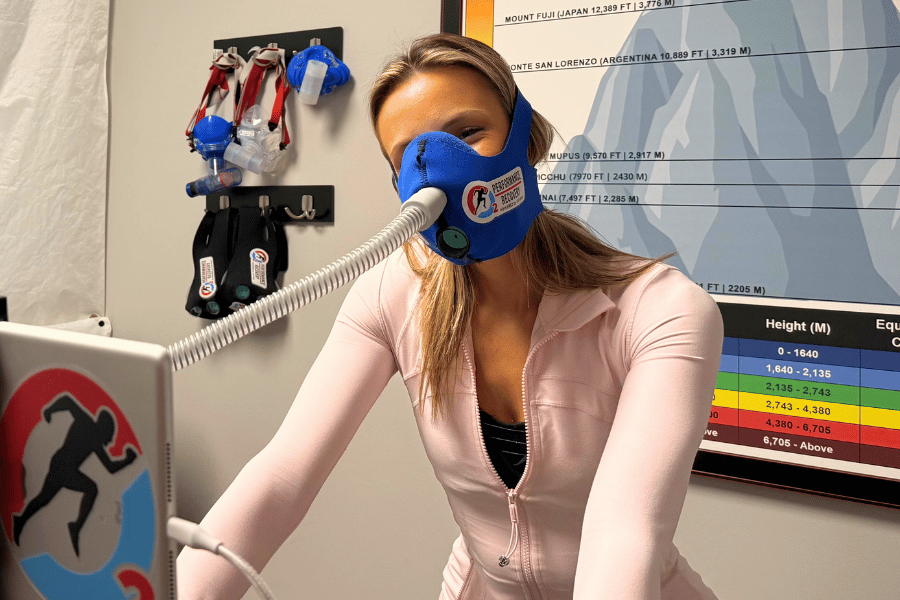
A session at O2 Performance and Recovery takes about 20–30 minutes. You wear a mask connected to our system, usually while riding a stationary bike at an easy pace. A recumbent bike is available for anyone who prefers more support. Every session includes breathing coaching from the Oxygen Advantage program. You can read the full walkthrough in What Actually Happens in an IHHT Session.
If you are wondering why you have never heard of any of this from your own doctor, we answered that directly in Why Don’t More Doctors Know About IHHT?
Frequently asked questions
What do mitochondria do?
Mitochondria convert the oxygen you breathe and the food you eat into ATP, the fuel your cells use for everything from muscle movement to thinking. Nearly every cell in the body contains them, and energy-hungry tissues like the heart, muscles and brain contain the most.
Can you increase the number of mitochondria in your body?
Yes. The body builds new mitochondria through a process called mitochondrial biogenesis, and regular demand is the main trigger. Physical activity is the most studied way to create that demand. Research into other methods, including intermittent hypoxic and hyperoxic training, is promising but still early.
Why do mitochondria decline with age?
With age, the body becomes slower at removing damaged mitochondria and building new ones, so worn-out ones accumulate. Some researchers note that part of this decline may reflect lower physical activity rather than age alone, which suggests there is room to influence it.
Does IHHT treat mitochondrial dysfunction?
No. We do not cure, treat or fix any condition. IHHT is a form of training that gives the body oxygen and energy, and the body does the rest. Anyone with a medical diagnosis should talk with their doctor, and clients tell us what changes for them from there.
Where can I try IHHT near Athens, GA?
O2 Performance and Recovery is in Watkinsville, serving Athens and the surrounding area, at 1021 Jamestown Blvd, Suite 215, Watkinsville, GA 30677. We are the only certified IHHT and Oxygen Advantage facility in Georgia, and every session includes breathing coaching.
Curious what this feels like in person?
Reading about mitochondria only goes so far. If you would like to see the equipment, ask your questions, and try a session at your own pace, we would be glad to have you.
Book an intro session at our studio in Watkinsville, serving Athens and the surrounding area.