

Being tired and feeling behind are two different things.
Tired is the morning after a hard game. It is a tournament weekend, a long drive home, or a week of training that took more than you had to give. Feeling behind is something else. It is the sense that your body taps out faster than you need it to, and that the fourth quarter shows up before your legs do.
At O2 Performance and Recovery, these are two different goals, and we address them with two different types of oxygen training sessions. Recovery sessions are designed to help your body return to baseline. Performance sessions are designed to elevate that baseline. Both use the same room and equipment, but they serve different purposes. The right approach depends on what you are asking your body to do at the time of the session.
And within either one, no two sessions are alike. Every session is individualized. We adjust how long you spend with lower oxygen, how long you spend with higher oxygen, and how much or how little you work on the bike, all around you. The kind of session sets the direction. The details are built for the person wearing the mask.
The short answer
| Recovery session | Performance session | |
|---|---|---|
| The goal | Get back to baseline | Raise your baseline |
| How the session is built | Build a demand for oxygen, then bring oxygen in well above normal | Most of the session spent in the lower-oxygen stretch |
| How it feels | The easier of the two | Asks more of you, on purpose |
| How often | After a game | Typically two to three times a week for eight to twelve weeks |
| Built for you | Oxygen timing and effort set to how you arrive that day | Oxygen timing and effort set to your goal and how you adapt |
| Best for | The day or week after hard effort | Building toward a season or event |
Watch a quick walk-through of the two sessions, then read on for the details.
First, what oxygen training actually is
The method we use is called IHHT, short for Intermittent Hypoxic Hyperoxic Training. In plain English, you breathe through a mask that gently lowers your oxygen intake, then raises it well above normal, and repeats that over about twenty to thirty minutes. It is the same concept as altitude training, without the mountain and all the gear.
When the oxygen drops, your body notices. It moves into a state of demand. Every oxygen training session uses that demand. The difference between our two sessions is what the demand is used for.
Here is the simplest way to picture it. A recovery session refills the tank. A performance session builds a bigger tank.
Recovery sessions: getting you back to baseline
A recovery session is built around the return of oxygen.
We gently lower the oxygen you are breathing until your body starts to want it. Then we bring in air that is well above normal. Because your system has just spent a few minutes asking for oxygen, that oxygen is driven deeper into tissue, into nerve endings, and into the brain. We repeat that a few times across the session.
How long each stretch lasts, and how much you pedal while it happens, depends on you and on how you walk in that day. A client coming off a full effort athletic game, for example, is not set up the same way as a client coming off a long flight.
Zachariah Branch, a wide receiver at the University of Georgia, would come in on Sundays after a game. In his words:
“…the next morning I’m feeling great, ready to go out there for practice.”
That is his experience, described his way. Recovery looks different for everyone, and your first session is where we learn what your body needs.
Performance sessions: raising your baseline
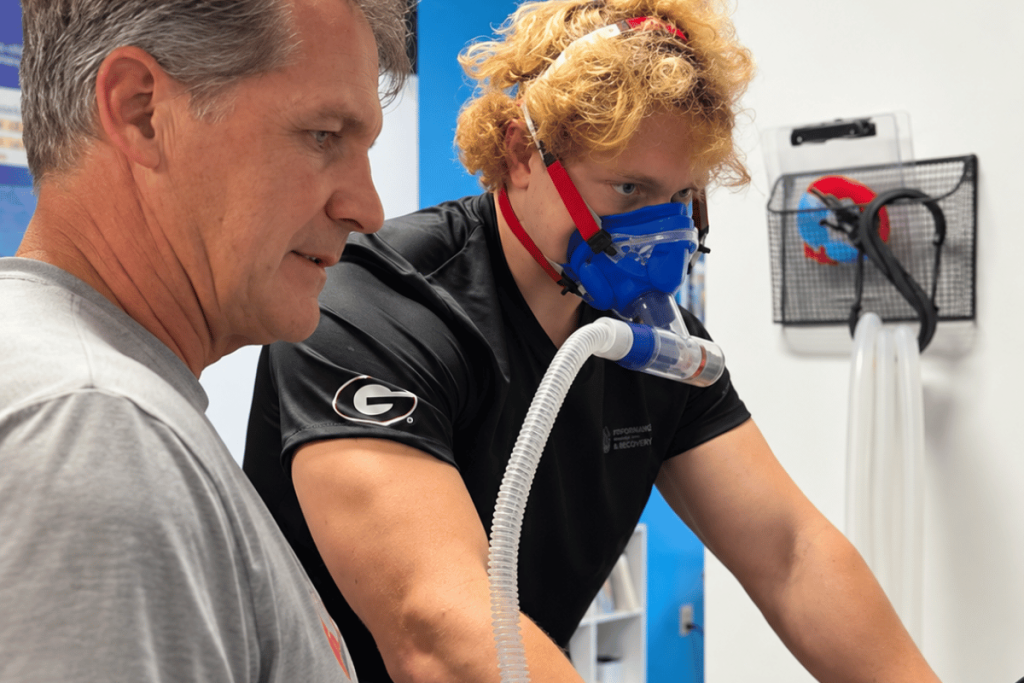
A performance session changes the balance. Most of the session is spent in the lower-oxygen stretch rather than building toward the return. The goal is adaptation.
When your body spends real time with less oxygen available, it treats that as information and starts to adjust. The science of how cells sense and respond to oxygen levels won the 2019 Nobel Prize in Medicine. The adaptation we are working toward is your body building new, stronger mitochondria. Those are the small structures inside your cells that turn the oxygen you breathe and the food you eat into usable energy. More capable cells mean more to draw on late in the game or in a busy lifestyle.
Oxygen training for athletic performance is an emerging field, and the researchers themselves are clear that larger trials are still needed. The principle remains true: the body adapts to demands placed on it again and again.
This is the part that takes patience. A typical performance program is twenty-minute sessions, two to three times a week, for eight to twelve weeks. Your body changes when it gets the same signal again and again, and it needs time to answer. The same is true of anything worth building, whether that is strength, a skill, or a habit. Two sessions and done will not get you there. Showing up week after week is what lets you see, and feel, the change.
It is also where individualizing matters most. As your body adapts, we change the session with it: more or less time with lower oxygen, more or less time with higher oxygen, and more or less effort on the bike. The session you do in week six is not the session you did in week one, because you are not the same athlete you were in week one.
It is the harder of the two. The effort is gentle, guided and short, but the lower-oxygen stretch asks something of you, and that is the point. A member of our team is with you for the whole session, coaching your breathing and adjusting as you go.
What a session looks like
Every session at O2 Performance and Recovery is individualized. Before you start, our experience and information about you will determine how long you will spend with lower oxygen, how long with higher oxygen, and how hard you will work on the bike. During the session, a member of our team adjusts all three based on how your body is responding. Two clients on the same kind of protocol will not have the same session.
Most clients ride a stationary bike. There is a recumbent bike for anyone who wants more support or has balance concerns, and a chair for anyone who cannot use either. The movement is part of the method: light exertion is what creates the demand for oxygen that the whole session depends on. That is also why the effort is one of the things we tailor to you.
You wear a mask, and the system handles the switch between lower and higher oxygen. Every session includes breathing coaching from the Oxygen Advantage program. It takes twenty to thirty minutes, and most people head straight back to their day. For a full walk-through, read What Actually Happens in an IHHT Session
Which oxygen training session is right for you?
You do not have to figure it out alone. Your body’s needs can change from week to week, or even from one day to the next, so choosing the right session is not a one-time decision. That is our job.
At your session, we talk through what your goals are, if you are training for something specific, how you are feeling, and what your schedule looks like. From there, the O2 Performance and Recovery team decides which kind of session fits and builds it around you. When your needs change, the session changes with them. You bring the goal, and we take it from there.
Frequently asked questions
- What’s the difference between recovery and performance oxygen training? Both alternate lower and higher oxygen through a mask. A recovery session builds a demand for oxygen and then brings oxygen in well above normal, so it reaches deeper into tissue. A performance session spends most of its time in the lower-oxygen stretch so the body adapts over weeks.
- Is every oxygen training session the same? No. Every session is individualized to the client. We adjust how long you spend with lower oxygen, how long you spend with higher oxygen, and how much or how little effort you put in on the bike, and we keep adjusting based on how you respond.
- How often should I come in, and can that change? That is something you and your coach at O2 Performance and Recovery work out together. How often you come in depends on your goal, your schedule, and how your body responds, and it is not set in stone. Some clients come in when they need to recover. Others follow a steady schedule over several weeks. As your season, your training, or your needs change, your coach adjusts your sessions with you.
- Is it safe to lower my oxygen? It is the question we hear most, and it is a fair one. The oxygen is lowered gently, and a member of our team is with you for the entire session, watching how you respond and adjusting as you go. If you are managing a health condition, talk it through with your doctor before you start.
- Do I have to be an athlete? No. We work with clients on recovery, breathing, brain health and longevity as well as athletic performance. These are simply the two shapes oxygen training can take, whoever is on the bike.
Find out which session fits your season
O2 Performance and Recovery is the only certified IHHT and Oxygen Advantage facility in Georgia. If you are looking for oxygen training or athletic recovery in Watkinsville or near Athens, the fastest way to choose is to come in and talk it through. Bring your schedule, your season, and your questions. We will build your session around what you bring. No pressure, just a clear look at the science.
Book a session at O2 Performance and Recovery in Watkinsville, serving Athens and the surrounding area.
Perform Better. Recover Faster.