

Tired All the Time but Your Bloodwork Is Normal? Here Is What Standard Labs Cannot See
You did the responsible thing. You went to the doctor, described the exhaustion, and had your blood drawn. The results came back, and everything was “normal.” Maybe you were told to sleep more, stress less, or that this is just what your forties, fifties, or sixties feel like.
You walked out with a clean report and the same problem you came in with.
If you are still tired in a way that sleep does not touch, foggy in the afternoon, and slower to bounce back than you used to be, you are not imagining it. And you are not alone. This is one of the most common frustrations we hear at O2 Performance and Recovery, and there is a real, physical explanation for it. It just tends to live in a place your standard labs were never designed to look.
Why “normal labs” and “no energy” can both be true.
Here is the part no one explains at the appointment. Standard blood panels are built to catch disease. They are very good at flagging anemia, diabetes, or a thyroid that has clearly stopped cooperating. They are not built to measure how well your body is running day to day.
There is also a difference between normal and optimal. A lab’s “normal” range is wide on purpose, because it is drawing a line between sick and not sick. You can land inside that range on iron, vitamin D, or thyroid markers and still feel the effects of running low. Normal on paper does not always mean thriving in your body.
So both things can be true at once. Nothing on the panel is broken, and you still feel drained. The report is not lying. It is just answering a narrower question than the one you actually asked.
What causes fatigue that does not show up on a blood test?
Plenty of things drain your energy without leaving a fingerprint on a standard CBC or metabolic panel. A few of the common ones:

- Several mild shortfalls at once. Borderline iron, low-ish vitamin D, and early blood sugar changes can each read as “not bad enough” on their own, while together they add up to a real energy deficit.
- Chronic stress and poor sleep quality. Sustained stress and broken sleep drain your reserves in ways bloodwork does not capture.
- Lingering effects of a past illness. Fatigue after a virus, including Covid, can hang on for months after the infection is gone.
These are worth ruling out with your doctor, and you should. But there is a deeper layer underneath most of them, and it is the one almost no routine panel measures.
The part most tests never check: how well your cells make energy.
Your energy does not come from your bloodstream. It comes from inside your cells, from tiny structures called mitochondria.
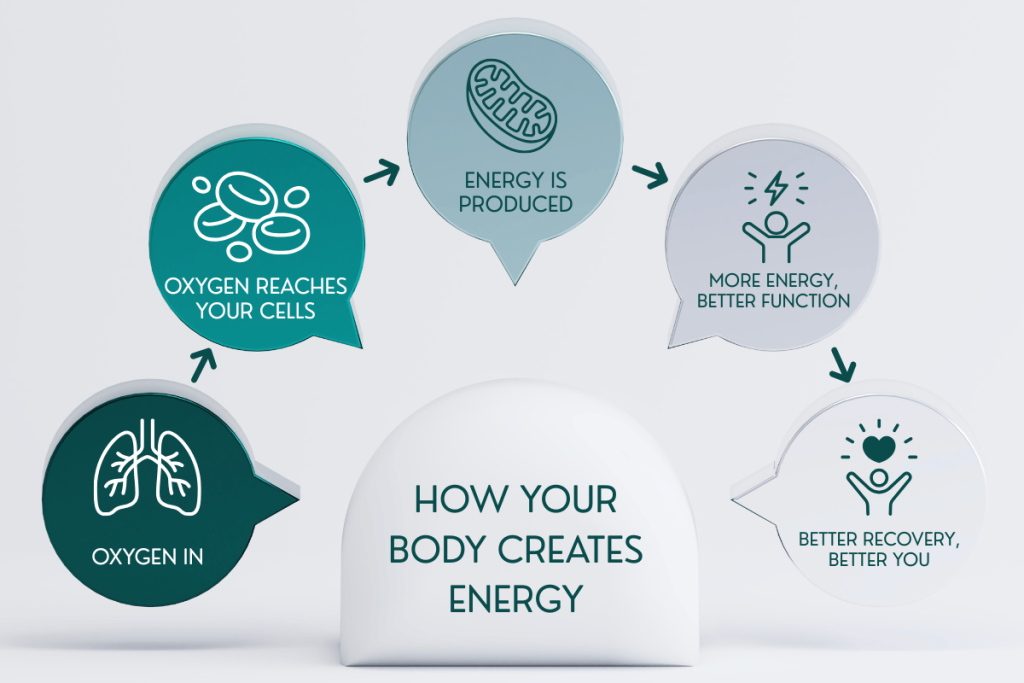
Mitochondria take the oxygen you breathe and the food you eat and turn them into ATP, which is the fuel that runs everything you do. Every heartbeat, every thought, every flight of stairs is powered by it. When your mitochondria are making plenty of ATP efficiently, you feel it. When they are running rough, you feel that too.
This is why the symptoms cluster the way they do. Your brain is one of the hungriest tissues in your body, so when cellular energy runs low, it often shows up first as brain fog, lost words, and afternoon mental fatigue. Your muscles are packed with mitochondria too, so the same shortfall can turn a normal walk or a set of stairs into something that leaves you winded and wiped out.
A standard blood test does not measure any of this. Your cells can be making energy inefficiently while every number on the page still reads as unremarkable. That gap, between how you feel and what the labs show, is exactly where this kind of fatigue lives.
Where oxygen comes into it.

Notice that oxygen is half of that equation. Your mitochondria cannot make energy without it. You can be breathing perfectly normally and still have cells that are not getting or using oxygen as well as they could.
This is the frame we work from at O2PR. We do not think about fatigue as a mystery. We think about it as a body that is short on two specific things: oxygen and energy. Give the body more of both, at the cellular level, and it tends to do what it is built to do.
“Is this just aging?”
This is the question we hear most, usually said quietly, because somewhere along the way people got the message that being tired is just the tax you pay for getting older.
Slowing down is not the same as running on empty. Feeling your age is not the same as feeling like a different person than you were three years ago. The fact that your labs are clean and you still feel this way is not proof that nothing is wrong. It is a sign that the answer is somewhere the standard workup does not reach.
What we actually do at O2 Performance and Recovery.
We are the only certified IHHT and Oxygen Advantage facility in Georgia, based right here in Watkinsville serving Athens and the surrounding areas.
IHHT stands for Intermittent Hypoxic Hyperoxic Training. During a session we gently lower the oxygen you breathe, then raise it well above normal, and repeat that a few times over about twenty to thirty minutes. That rise and fall creates a demand your body responds to. It drives oxygen deeper into your tissue and builds stronger, more efficient mitochondria over time.
We do not do this to you. We give your body the raw materials it has been short on and let it get back to work. Every session also includes breathing coaching from the Oxygen Advantage program, and we pair the training with PEMF to support recovery at the cellular level. We do not cure, treat, or fix anything. We give the body oxygen and energy, and clients tell us what changes from there.
Why you may never have heard of this.
If IHHT is this straightforward, a fair question is why your doctor never mentioned it. That is one of the most common things people ask us, and it deserves a real answer rather than a shrug. We take it on directly in Why Don’t More Doctors Know About IHHT? . The short version is that most physicians are trained to find and name disease, and this is a different kind of tool, one aimed at how the body performs rather than at a diagnosis.
Frequently asked questions
Why am I so tired if my blood tests are normal? Standard blood tests are designed to detect disease, not to measure how efficiently your cells produce energy. You can have normal labs and still feel exhausted if your mitochondria, the parts of your cells that turn oxygen and nutrients into fuel, are running inefficiently, or if several markers are technically normal but not optimal.
What is mitochondrial dysfunction? Mitochondria are the structures inside your cells that convert oxygen and food into ATP, your body’s usable energy. When they underperform, the result can be deep fatigue, brain fog, and slow recovery, even when a routine blood panel looks fine.
Can low oxygen at the cellular level cause fatigue? Oxygen is one of the two ingredients your cells need to make energy. If your cells are not getting or using oxygen efficiently, energy production can suffer, and fatigue and brain fog often follow.
Is IHHT safe? IHHT is a guided training protocol, not something that happens to you. The oxygen levels are controlled and coached the entire time, and sessions are built around what your body can handle. If you have questions about whether it is a fit for you, an intro session is the place to start.
Where can I try IHHT near Athens, Georgia? O2 Performance and Recovery is the only certified IHHT and Oxygen Advantage facility in Georgia, located between Athens and Bogart. We offer intro sessions for people who want to feel it for themselves before committing to a package.
If you are tired of being told you are fine
You know your own body. If the labs keep coming back clean and the exhaustion keeps coming back too, the problem may be one your standard workup was never built to see.
Book an intro session at O2 Performance and Recovery and let us walk you through what IHHT is, how it works, and whether it makes sense for you. No pressure, just a clear look at the science and a chance to give your body the two things it may have been missing all along.
Perform Better. Recover Faster.