

Your Body Runs on Electricity Too.
Here is something most people never get told, and it changes how the rest of this makes sense.
Your body does not just run on food and oxygen. It runs on electricity.
Not as a metaphor. Every cell in you holds an actual electrical charge across its outer membrane, like a very small battery. Your nerves do not send messages chemically alone, they fire on voltage. Your heart keeps time because an electrical signal sweeps through it, which is precisely what an ECG is drawing on the paper. When a doctor puts paddles on a chest, they are not adding energy in a vague sense. They are resetting an electrical system.
This is ordinary, established biology. It is in every physiology textbook. And once you know it, an obvious question follows.
If the body is electrical, can you talk to it electrically?
That question is what pulsed electromagnetic field therapy is an attempt to answer, and researchers have been working on it for a long time.
What PEMF actually does, physically.
The mechanism is simpler than the name.
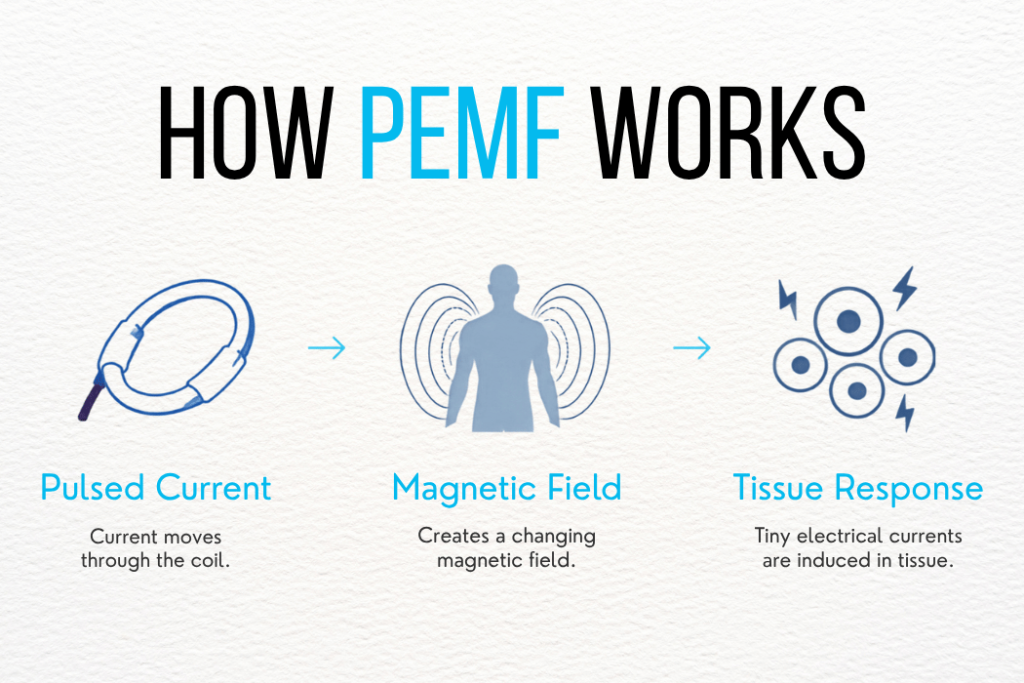
A coil carries a current and produces a magnetic field. Pulse the current on and off, and the field rises and falls with it. And here is the part that matters: a changing magnetic field passing through anything conductive produces a small electrical current inside it. Tissue is conductive. So a pulsing field passing through your body generates tiny currents in the tissue itself.
You lie on a mat or sit in a chair. We use coils as well. The field passes through you, and on the other side of it there is a very small electrical signal where there was not one before.
That is the entire idea. Our own PEMF page puts it more simply: gentle electromagnetic pulses that stimulate your body’s natural healing processes at the cellular level.
What is PEMF therapy used for in medicine?
Before anything else, it is worth knowing that this is not a new or exotic idea.
A 2016 review in the journal Cancer Medicine describes the established uses in one line. Pulsed electromagnetic fields in the 0 to 300 Hz range are, in the authors’ words, “a therapeutic tool extensively used for the treatment of several pathologies including osteoarthritis, Parkinson’s disease, postsurgical pain and edema, treatment of chronic wounds, and facilitation of vasodilatation and angiogenesis.”
Translated: joint pain, swelling after surgery, wounds that heal slowly, and blood flow. Orthopaedic medicine has used electromagnetic stimulation on fractures that refuse to knit for decades. This is the mature, unglamorous, well-worn end of the field, and it is where the confidence is highest.
The finding that made researchers pay closer attention.
Now to the part that is genuinely interesting, and the reason PEMF has stayed in the laboratory conversation rather than fading out.
Researchers kept noticing that these fields do not seem to affect all cells equally.
A 2013 study in PLOS ONE grew human breast cancer cells and normal human breast cells side by side and exposed both to exactly the same PEMF settings, for an hour a day over three days. The cancer cells died. The normal cells carried on. Same field, same room, same exposure, two very different outcomes
The proposed explanation is not mystical. Cancer cells divide constantly, and dividing cells build an internal scaffold to pull themselves apart. That scaffold is electrically sensitive. A cell that is not dividing does not have one assembled in the same way, so there is far less for the field to interfere with. Rapid division appears to be what makes a cell vulnerable here, and healthy tissue is mostly not doing that.
The same pattern showed up in animals. In that same Cancer Medicine review, rats with liver cancer and healthy rats were both given PEMF. In the healthy rats, examination of the liver tissue afterwards found no changes at all. The field passed through and left normal tissue exactly as it was.
The review summarises the whole picture with the phrase “lack of toxicity for non-cancerous cells.”
What that does and does not mean.
What it does not mean. It does not mean that PEMF is the magical cure that we have all been waiting for. Almost all of this work has been done in laboratory dishes and in animals. The human studies that exist are very small and very few. Nobody in that field is claiming otherwise, and the researchers themselves write plainly that larger controlled trials are needed before anyone draws conclusions. We are not offering PEMF as a treatment for any disease, and if you have a diagnosed condition the person to talk to is your doctor.
What it does mean, and why we find it worth telling you. Two things happened at once in that research. In addition to shrinking tumor cells , the field did not harm the good cells.
A great many things can affect a diseased cell. Most of them damage healthy tissue on the way, which is exactly why conventional cancer treatment is so hard on the people receiving it. An approach that appears to leave normal cells undisturbed is interesting for that reason first.
What we use PEMF therapy for here
Nothing above is why anyone books a session, and we are not going to pretend it is.
What we list PEMF for is in this page, and it sits in the well-established part of the research rather than the frontier: pain relief and management, recovery from injuries, better sleep quality, reduced inflammation, enhanced athletic performance, improved energy levels, and overall wellness and vitality.
A session takes 15 to 30 minutes. You stay fully clothed and relax comfortably. Most people feel a gentle pulsing or warming sensation, or nothing at all. O2 Performance and Recovery has PEMF Certified trainers, and we guide your session.
If you have read our post on the kind of tired that sleep does not fix, this connects to it directly. IHHT works on your cells through the air you breathe. PEMF comes at the same cells from the electrical side. Different route, same underlying question, which is how well your cells are actually running.
Frequently asked questions
Is my body really electrical? Yes, and it is not a figure of speech. Cells hold a charge across their membranes, nerves fire on voltage, and your heart is coordinated by an electrical signal. An ECG is a recording of it.
What does PEMF do? A pulsing magnetic field passes through the tissue, and that field produces very small electrical currents inside it. You sit in a chair for a session, or you lie down on a mat if you prefer. We use coils as well.
What is PEMF best established for? Bone and joint pain, swelling after surgery, slow-healing wounds, and circulation. Orthopaedic medicine has used electromagnetic stimulation on difficult fractures for decades.
Why do researchers say it does not harm healthy cells? In laboratory studies, the same PEMF exposure that affected rapidly dividing cells left normal cells unaffected. Rapid division appears to be what makes a cell susceptible. Most healthy tissue is not dividing rapidly.
Does that mean PEMF treats disease? No. That research is early and mostly in cells and animals. We offer PEMF as a wellness session, not a medical treatment. Speak to your doctor about any diagnosed condition.
Will I feel anything? Most people feel a gentle pulsing or warming sensation, or nothing at all. Feeling very little is normal and expected.
Come and see what it is.
If any of this is interesting, the best thing to do is ask questions. For quicker response text us through 706-424-3449 or you can visit us at 1021 Jamestown Blvd, Suite 215, Watkinsville.