
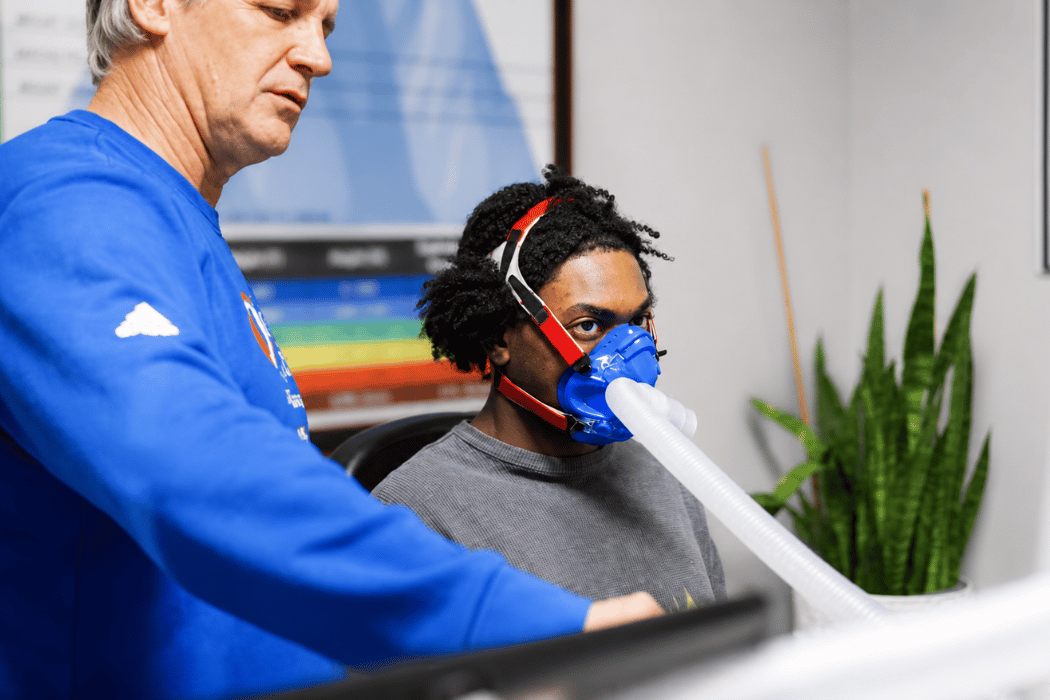

What Actually Happens in an IHHT Session
You have probably seen the mask. Someone at the gym, strapped into a black training mask with the valves on the front, breathing hard between sets and looking like they are trying to summit a mountain on the way to the water fountain. The idea behind it is real. Train with less available oxygen, and the body adapts. The execution is mostly theater. Those masks make it harder to pull air in. They do not actually change the air.
What we do at O2 Performance and Recovery starts from the same real idea and takes the theater out of it. It is called IHHT, and the shortest honest description is this: altitude training, at sea level, in about half an hour, without the mountain and without the gimmick.
This post is about what that actually looks like, start to finish, because “we lower your oxygen on purpose” sounds a great deal stranger than it feels once a session is underway. If you have been curious about the room but not sure what you would be walking into, this is the walk-through.
First, what IHHT actually is.
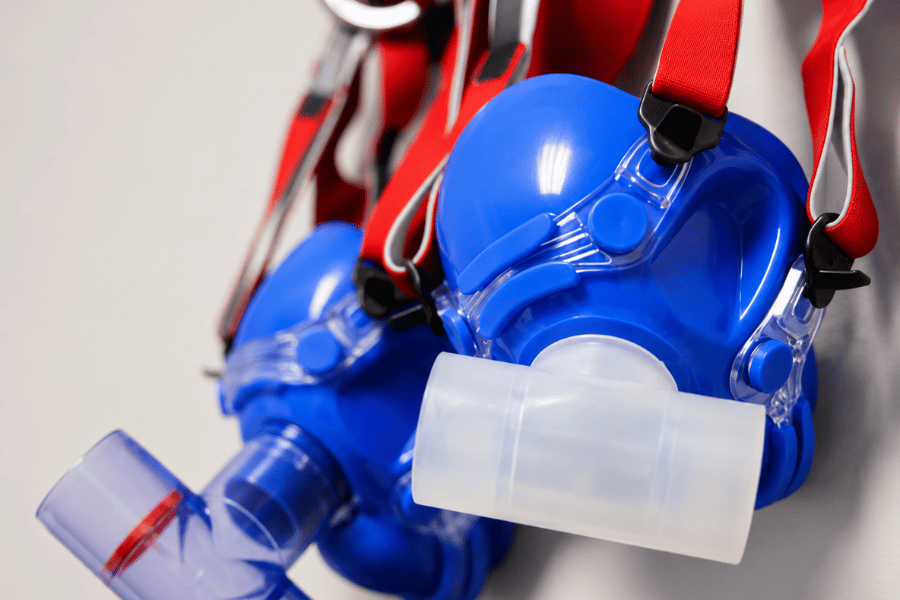
IHHT stands for Intermittent Hypoxic Hyperoxic Training. Break the name apart and it explains itself. Intermittent, because it comes in short alternating stretches rather than one long push. Hypoxic, the low-oxygen stretch. Hyperoxic, the high-oxygen stretch. Training, because that is the category it belongs to. It is not a drug, not a procedure, and not something done to you while you wait. It is something your body does, gently guided, in a set of cycles.
The method grew out of EWOT and the wider world of altitude conditioning, and it has been used in European clinics for years. What is newer is the modern understanding of why it works, which we wrote about separately in why your doctor may never have mentioned it. Here we are staying on the practical question: what happens in the room.
“Altitude training at sea level” is the whole idea.
Athletes have known for a century that training high in the mountains does something useful. The air up there holds less oxygen, the body senses the shortage, and it responds by getting better at carrying and using what oxygen it has. The problem is that most people cannot move to Colorado for a month, and the mountain does not care whether today is convenient.
IHHT recreates the useful part of that shortage in a controlled way, indoors, in about the time it takes to watch one episode of something. We gently lower the oxygen you are breathing to create a mild demand, roughly what you would breathe partway up a mountain, and then we raise it well above normal. Down, then up, a few times, over twenty to thirty minutes. The word doing the heavy lifting there is “gently”. This is a nudge, not a plunge, and you are watched the entire time.
Why does the low-then-high swing do anything?
Inside almost every cell in your body are mitochondria, the tiny engines that take the air you breathe and the food you eat and turn them into the usable energy that runs everything you do. When those engines are sluggish or thinned out, you feel it as the kind of tired that sleep does not fix.
The low stretch of a session is a signal. When your cells briefly sense less oxygen, the body reads it as a demand and starts to respond, the same way it would at altitude. The high stretch then floods the system with more oxygen than usual, giving that response something to work with. Do that a few times and you are asking the body to build more of the machinery that carries and uses oxygen, and to clear out the engines that were not pulling their weight.
That is the honest answer to “how do you increase your mitochondria.” You do not add them from the outside. You create a demand, and the body builds them itself. We do not do anything to you. We give the body a reason and the raw material, and it does the work it was built to do.
So, minute by minute, what is a session?
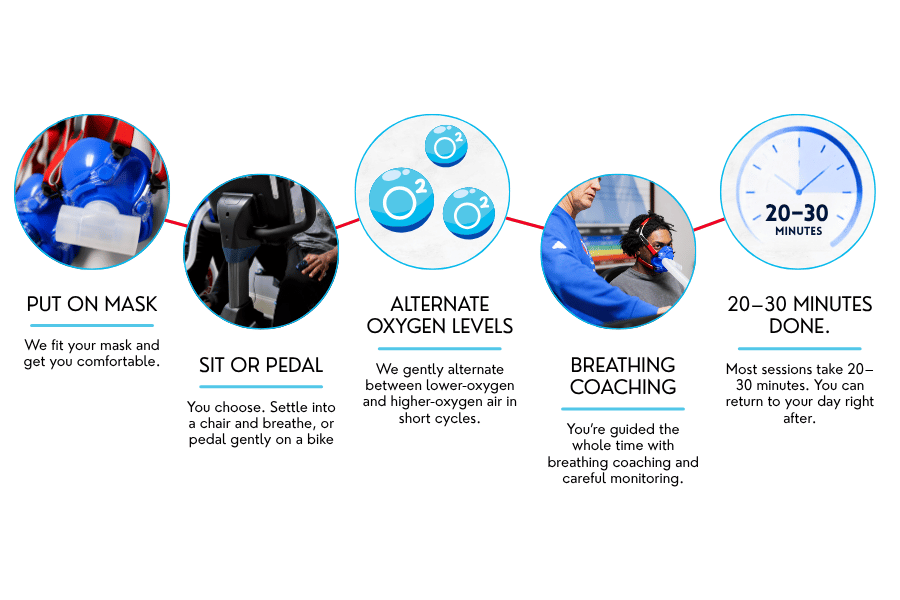
Here is the part people are actually asking about, and here is where a lot of descriptions online get it wrong.
You choose how you spend it. You can settle into a massage chair and simply breathe, which is what plenty of clients do. Or you can pedal gently on a bike, at a pace you could hold a conversation through, and there is a recumbent bike if you want the bike with more back support. Neither is the proper way to do it and neither is the shortcut. Take whichever one sounds like a better twenty five minutes to you.
You wear a mask that delivers the air, switching between the low and high stretches for you. You do not manage anything. You breathe.
We talk you through it, and we watch the whole time. Every session includes breathing coaching from the Oxygen Advantage program, so you are not guessing at how to breathe. You are being coached through it, cycle by cycle, by someone watching how you are doing and adjusting as needed.
It takes twenty to thirty minutes, and most people go straight back to work afterward. There is no recovery room, no grogginess to sleep off, no rest of the day written off. You came in, you gave your cells a workout without giving your legs one, and you get on with the day.
It is a program, not a single visit.
One thing we say to everyone, because it is true and because it is fair: a single session is an experience, and an experience is not an adaptation. The body builds slowly and it builds in response to a repeated signal, not a one-time one.
In practice that means the first month runs a few sessions a week, and maintenance settles down to something much lighter, often a session a week or a few a month. We work the exact rhythm out with each person, because suitability and pace are individual. That conversation is part of the first visit, not an upsell after it.
Is it safe?
It is the second question almost everyone asks, right after “what is it,” and it deserves a full answer of its own, which we will give it in a dedicated post soon. The short version: the oxygen is lowered gently and briefly, never to some dramatic extreme, you are monitored the entire session, and we work out suitability with each person before they begin. The demand is meant to be a nudge the body can respond to, not a stress it has to survive. If IHHT is not the right fit for someone, the responsible thing is to say so, and we do.
Frequently asked questions
What is IHHT? IHHT stands for Intermittent Hypoxic Hyperoxic Training. It alternates short stretches of lower-oxygen and higher-oxygen air, breathed through a mask, while you pedal gently on a bike, over about twenty to thirty minutes. The alternating demand prompts the body to build stronger, more efficient mitochondria, the cellular engines that turn oxygen into energy.
How does an IHHT session work? We gently lower the oxygen you are breathing to create a mild demand, roughly what you would breathe partway up a mountain, then raise it well above normal, and repeat that a few times across the session. The low stretch signals the body to adapt; the high stretch gives that adaptation something to work with. You are coached and monitored throughout.
Is IHHT the same as an altitude training mask? No. Those masks make it harder to draw air in, but they do not change how much oxygen the air contains. IHHT actually adjusts the oxygen level of the air you breathe, in a controlled, monitored way, which is the part the mask only pretends to do.
Do I just sit there during a session? You can, and plenty of clients do. Settle into a chair, put the mask on and breathe, and the session works. If you would rather be moving, you can pedal gently on a bike instead, at an easy conversational pace. Both are normal. What creates the demand your body responds to is the air you are breathing, not the pedalling.
How often do I need to come in? The first month is usually a few sessions a week, and ongoing maintenance is lighter, often about one session a week or a few a month. We work out the right pace with each person, because a single session is an experience and lasting change comes from a repeated one.
Where can I try IHHT near me in Georgia? O2 Performance and Recovery is in Watkinsville, serving Athens and the surrounding area, and is the only certified IHHT and Oxygen Advantage facility in Georgia. An intro session is the best way to see it for yourself and ask anything you want.
Come see a session for yourself.
The easiest way to understand IHHT is to watch one happen, and the best way is to feel one. If you have been searching for hypoxic training near you, or you just want to see what all of this actually looks like in person, come in with your questions and your doubts. We would rather show you the science up close than ask you to take our word for it.
Book an intro session at O2 Performance and Recovery in Watkinsville. No pressure, just a clear look at what happens in the room and why.
Perform Better. Recover Faster.