

It is the question we hear more than any other. Someone learns what we do at O2 Performance and Recovery, they start to feel interested, and then they pause and ask the obvious thing: “If this actually works, why has my doctor never mentioned it?”
That is a fair question. It deserves a real answer, not a shrug and not a sales pitch. So here it is, straight.
The short version: your doctor is not hiding anything, and the fact that IHHT is unfamiliar to them says almost nothing about whether it works. It says a lot about how new the science is, how doctors are trained, and how treatments make their way into a typical exam room. Let us walk through it.
If you landed here still exhausted after a clean set of labs, you may also want to read why you can feel drained when your bloodwork looks normal. This post picks up the trust question that one leaves open.
The science underneath it is genuinely new.
Start with the thing most people do not realize. The science of how your cells sense and respond to oxygen is recent. Very recent.
In 2019, the Nobel Prize in Medicine went to three researchers for discovering exactly that, how cells detect oxygen levels and adapt to them. That work explains why a controlled dip in oxygen can prompt the body to build new blood vessels, make more red blood cells, and run its energy systems more efficiently. It is the biology that IHHT is built on, and it was recognized at the highest level of medicine only a handful of years ago.
Here is the part that matters. In medicine, there is always a long gap between a discovery and the day it shows up in your family doctor’s office. Estimates for that lag are often measured in a decade or more. A physician who finished training before 2019 simply did not learn this in school, because the framework did not exist yet.
Doctors are trained to name and treat disease.
Think about what a standard appointment is built to do. Your doctor is trained, brilliantly, to find what is wrong and address it, usually with medication, a procedure, or a referral. That system saves lives every day.
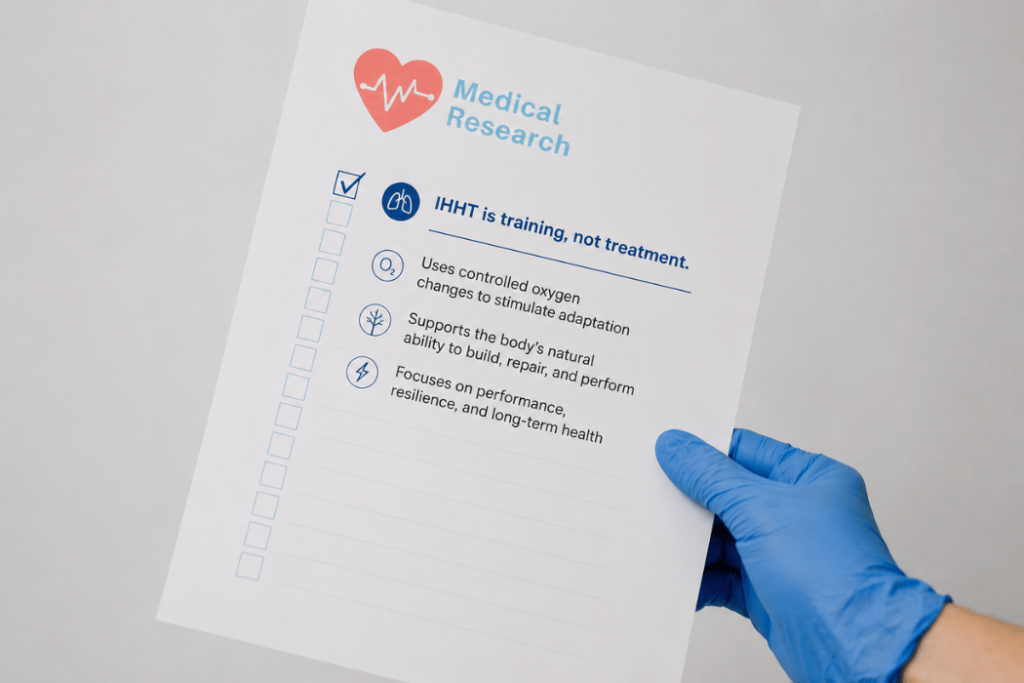
But it is a system built around disease. When your labs come back clean and there is no diagnosis to name, the standard toolkit runs short, and the honest answer becomes “everything looks fine.” IHHT is not a drug and not a procedure. It is training. It sits in a different category, the one focused on how the body performs rather than on what disease it has. That category rarely comes up in a fifteen-minute visit built around a diagnosis code.
It came up through a different door.
IHHT did not start in an American hospital. Its roots run through Soviet aerospace and sports medicine, going back to the 1930s, when researchers were working out how to help pilots and later athletes adapt to thin air at altitude. Over the following decades it was refined into the training model used today, and it was adopted widely in European clinics well before it reached the United States.
So the tradition your doctor trained in and the tradition IHHT grew out of are two different lineages that are only now meeting. If you were educated in one, the other looks unfamiliar, no matter how sound it is.
There is no sales rep for oxygen.
This one is less comfortable to say, but it is true and it matters. A large part of what reaches a doctor’s attention gets there because someone is marketing it or because insurance pays for it. New medications arrive with sales teams and studies in hand. Procedures come with billing codes.
Oxygen and breathing have neither. There is no company sending representatives to promote fresh air, and there is no tidy reimbursement code for building stronger mitochondria. Something can be effective and still stay off the radar simply because no industry has a reason to push it into the room. Absence of marketing is not the same as absence of merit.
The research is real, and it is still growing.

We will not overstate this, because overstating it would be the opposite of what we stand for. IHHT is an emerging field. There are published studies looking at its effects on exercise capacity, cognitive performance, and metabolic markers, including early clinical work in areas like post-Covid rehabilitation. The results so far are promising, and the researchers themselves are clear that larger trials are still needed.
That is not a weakness to hide. That is what honest, developing science looks like. The mechanism is well understood and Nobel-recognized. The clinical evidence is building. Both things are true at once.
So what does this actually mean for you?
It means “my doctor never mentioned it” and “it does not work” are two completely different statements, and it is easy to mistake one for the other.
Not knowing about something is not the same as it being unproven. It is not the same as being unsafe. It usually just means the thing has not yet traveled the long road from discovery, through training programs, past insurance desks, and into a routine appointment.
It also does not mean you should go around your physician. Just the opposite. IHHT is training that works alongside good medical care, not in place of it. Keep your doctor in the loop. Bring them your questions. In fact, some of the people who train with us are physicians themselves, which tells you something about who takes this seriously once they look closely.
The bottom line.
We do not cure or treat anything at O2 Performance and Recovery. We give the body the two things it is often short on, oxygen and energy, and we let the body do what it is built to do from there. We are the only certified IHHT and Oxygen Advantage facility in Georgia, and we are glad to explain the science to you, and to your doctor, in as much detail as you want.
Frequently asked questions
Why don’t doctors recommend IHHT? Most physicians were trained before the science of cellular oxygen sensing was widely established. Medical training centers on diagnosing and treating disease, usually with medication or procedures, while IHHT is a form of training focused on how the body performs. It also lacks the marketing and insurance billing codes that bring most new options to a doctor’s attention. Unfamiliarity reflects how treatments spread, not whether they work.
Is IHHT backed by science? The underlying biology, how cells sense and adapt to oxygen, earned the 2019 Nobel Prize in Medicine. There is a growing body of published research on IHHT’s effects on exercise capacity, cognition, and metabolic markers, with early clinical studies underway. Researchers agree the mechanism is sound and that larger trials will continue to build the evidence.
Is IHHT new? The training model has roots in Soviet aerospace and sports medicine dating back to the 1930s and has been used in European clinics for years. What is new is the modern scientific understanding of why it works, which is only recently established, and its arrival in the United States.
Should I talk to my doctor before trying IHHT? Yes. IHHT is designed to complement medical care, not replace it. We encourage you to keep your physician informed and to bring any questions to us or to them.
Where can I learn more about IHHT in Georgia? O2 Performance and Recovery, located between Athens and Bogart, is the only certified IHHT and Oxygen Advantage facility in Georgia. An intro session is the best way to see the science up close and ask anything you want.
Ask us the hard questions.
The best clients we have are the ones who came in skeptical and asked us to prove it. We would rather earn your trust than assume it.
Book an intro session at O2 Performance and Recovery. Bring your questions, bring your doubts, and let us show you the science behind what we do and how it works.
Breathe Better. Live Better.