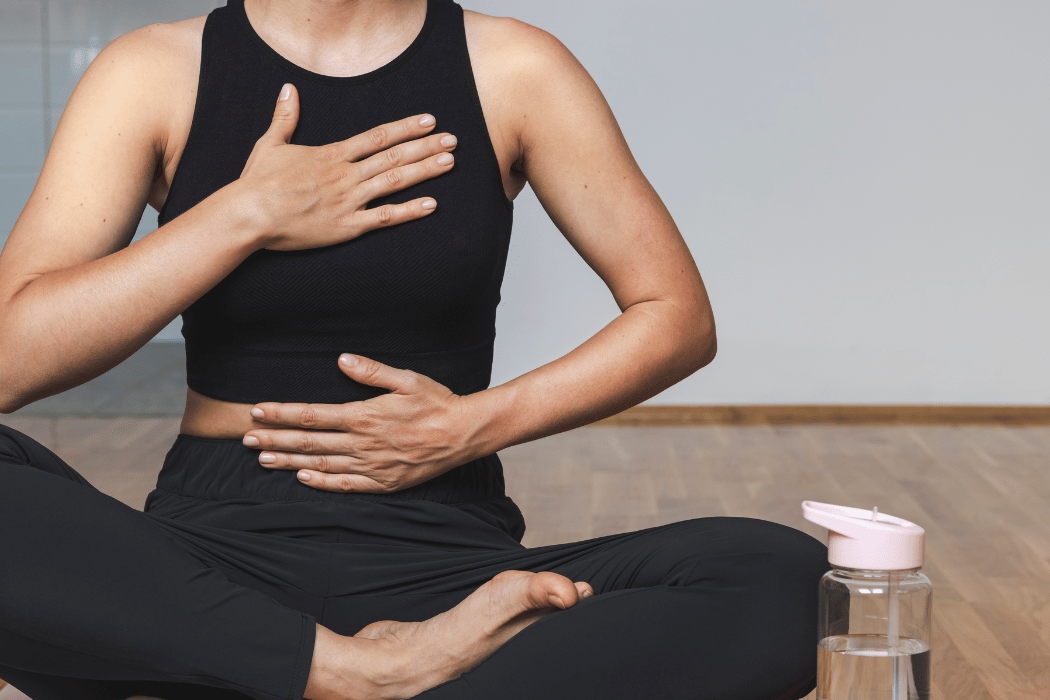

Holding your breath looks like the least productive thing you could do with a minute. No movement, no output, no obvious training effect. And yet breath holds have become a serious tool for athletes and for anyone who cares about how well their body uses oxygen, because a well-placed hold is not really about going without air. It is about raising carbon dioxide, deliberately and in a controlled way, and teaching the body to stay calm and efficient while it does.
If you have started reading about breath-hold training, you have probably run into two versions that sound almost opposite: holding on a full breath, and holding on an empty one. They feel completely different, they are used for different reasons, and confusing them is the fastest way to make the practice unpleasant. Here is what each one actually trains.
The idea underneath both of them
The urge to breathe is not mainly a signal that you are low on oxygen. It is a response to rising carbon dioxide. Your body tracks carbon dioxide closely and triggers the drive to breathe well before oxygen becomes a real problem in a short hold. That single fact is why breath-hold training works at all. You are not training yourself to survive on less oxygen so much as training your tolerance to carbon dioxide, and your composure while it climbs.
It also helps to know that carbon dioxide is not simply waste to be dumped as fast as possible. Your body uses it. Oxygen travels through your bloodstream held onto by your red blood cells, and something has to tell them where to let go of it. Carbon dioxide is that signal. Tissue that is working hard produces more of it, and that rise is what loosens the grip and releases oxygen right there, at the muscle doing the work.
It is less like a truck dumping cargo evenly down a street, and more like a driver who stops at the house with the porch light on. Carbon dioxide turns the porch light on.
The Danish physiologist Christian Bohr described this in 1904, and it still carries his name. It is worth knowing because it changes what breath-hold training is actually for. You are not teaching yourself to get by on less oxygen. You are training your tolerance to the very signal that tells your blood where to deliver it.
Full lung breath holds
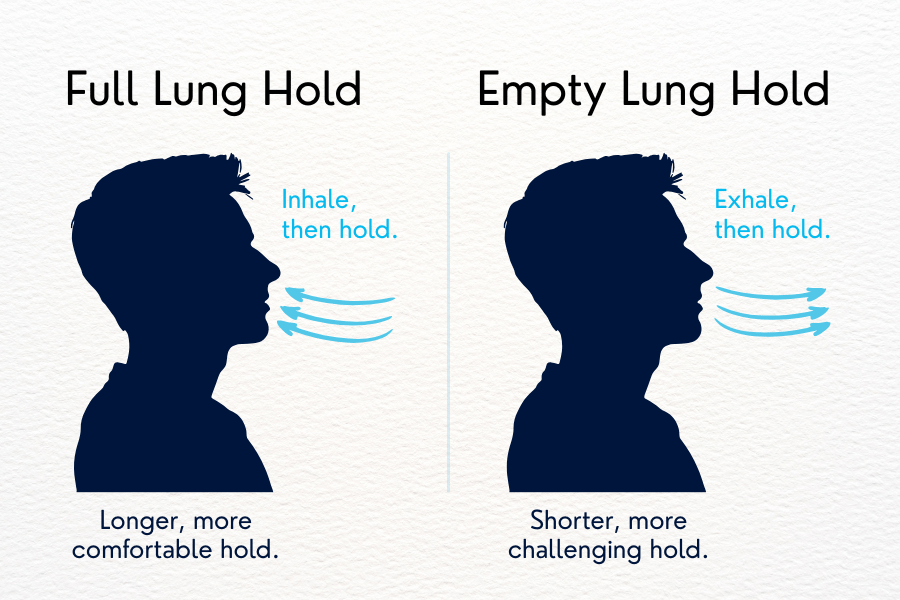
A full lung hold is the one most people do instinctively: take a big breath in, then hold. It is the longer and more comfortable of the two, for two reasons that stack on top of each other.
The obvious reason is that you have banked more air, and therefore more oxygen, to draw on. The less obvious reason is mechanical. Full lungs are stretched lungs, and that stretch itself quiets the drive to breathe. The physiology here is well established: increasing the stretch in your lungs lowers the urge to breathe, while rising carbon dioxide raises it. A full breath works both levers in your favor at once, which is why the hold feels unhurried and the contractions arrive late.
This is the version freedivers use for what they call oxygen tables, where the goal is to grow calm and comfortable with the tail end of a long hold. In plain terms, the full lung hold trains you in capacity and composure. It is the patient one.
Empty lung breath holds
An empty lung hold turns all of that around. You breathe out, then hold on near-empty lungs. Freedivers call these negatives, and the point of them is not to last a long time. It is the opposite.
With less air banked, carbon dioxide climbs quickly from a lower reserve, and the calming stretch of full lungs is gone. So the urge to breathe arrives fast, and so do the involuntary contractions of your diaphragm, the broad sheet of muscle beneath your lungs that does most of the work of breathing. Sometimes within seconds. That is the whole purpose. An empty lung hold compresses the hard part of a long hold into a short, honest window, which makes it a time-efficient way to train carbon dioxide tolerance and to practice staying relaxed when your body starts asking loudly for air.
Empty lung holds do two other useful things. They mimic the feeling of compressed lungs at depth without a diver going anywhere near deep water, and they gently work the flexibility of the diaphragm. Freediving coaches also use them to reduce residual volume, the air you cannot voluntarily push out.
One distinction matters more than any other here, because it is where people get hurt. The gentle, everyday version taught in breathing programs like Oxygen Advantage uses a normal, relaxed breath out, not a forced one, followed by a calm hold. The freediver’s negative, a full and deliberate exhale down to near-empty, is a much more aggressive tool. Both get called empty lung holds. They are not the same intensity, and they do not carry the same risk.
If a comparison helps: a full lung hold is a road trip that starts with a full tank, where the low-fuel light stays off for a good while. An empty lung hold is the same drive with the light already blinking, on purpose, so you can practice staying calm and driving well while it does. One trains endurance. The other trains your response to the warning itself.
How you measure any of this
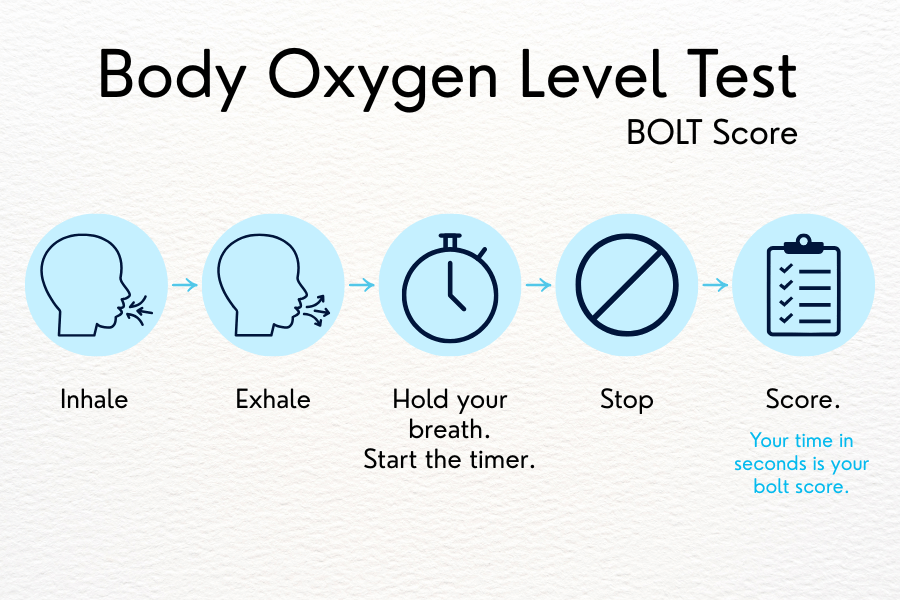
The simplest yardstick comes from the Oxygen Advantage method, and it is called the BOLT score, short for Body Oxygen Level Test. You take a normal breath in through the nose, let a normal breath out, then time the seconds until the first definite urge to breathe, not the maximum you can white-knuckle. It is a gentle, relaxed-exhale hold, much closer to the everyday version above than to a freediver’s negative.
A low score tends to travel with over-breathing, meaning habitually moving more air than your body actually needs, and with more breathlessness during exercise. The honest surprise for most fit people is how low they start. The number matters less than the direction. You train gently and consistently, and you watch it climb. Patrick McKeown, who developed the test and wrote The Oxygen Advantage, uses it precisely because it turns something invisible into something you can track.
What the body adapts
With consistent, sensible practice, a few adaptations show up in people who train breath holds. Tolerance to carbon dioxide rises, which is the headline. The diving response, the old mammalian reflex that slows the heart and shifts blood toward the core when you hold your breath, tends to become more pronounced. Athletes who train this way often report better recovery and less breathlessness at the same effort.
We will bound that honestly, the way we bound everything. Some of it is well-established physiology, and some of it is still being measured in larger trials. The mechanism is sound. The size of the effect is exactly the kind of thing careful researchers are still working out. We would rather tell you that than sell you a number we cannot stand behind.
Athletes tend to care about one thing above all with this work, and it is not a personal best on a breath hold. It is the morning after.
One of the University of Georgia players who trains with us described it after a heavy game: “My last game I actually played the most snaps I played all season, and I still felt pretty good at the end of the game. Like, I could have still kept playing.” A snap count is a number he did not have to be told. That is the kind of proof this audience trusts.
Where this fits, and where to be careful
At our studio in Watkinsville, breath-hold work is not a stunt you do alone in a corner. It is folded into coaching from the Oxygen Advantage program, taught by a certified instructor, alongside the IHHT training that is the core of what we do. IHHT stands for intermittent hypoxic hyperoxic training, and in plain terms it means this: we gently lower the oxygen you breathe for a short while, then raise it well above normal, and repeat that a few times over about twenty to thirty minutes. The dip creates a demand, and the body answers it. That matters for results, and it matters more for safety.
Please take this next part seriously, because the same fact that makes breath holds useful makes it dangerous when handled carelessly. Because the urge to breathe is driven by carbon dioxide and not oxygen, it is possible to blunt that urge and pass out from low oxygen before you ever feel the alarm. This is not hypothetical. Deliberate heavy breathing before underwater breath holds has killed swimmers who felt completely fine right up until they did not. So, two rules with no exceptions: never do breath holds in or near water, and never hyperventilate to extend a hold, meaning never breathe hard and fast on purpose beforehand to buy yourself more time. Empty lung holds in particular reach low oxygen faster, which is exactly why they belong with coaching rather than with curiosity.
Frequently asked questions
What is the difference between full lung and empty lung breath holds?
A full lung hold starts with a big breath in. You have more oxygen banked, and the stretch of full lungs quiets the urge to breathe, so the hold is longer and calmer. It trains capacity and composure. An empty lung hold starts with a breath out. Carbon dioxide climbs fast from a smaller reserve, the urge arrives quickly, and it trains carbon dioxide tolerance, diaphragm flexibility, and the feeling of depth without depth.
Are empty lung breath holds safe?
Done calmly, on land, without any prior heavy breathing, a relaxed-exhale hold is generally well tolerated by healthy people. The forced freediver version is more advanced and belongs with coaching. Two rules never bend: never in or near water, and never after hyperventilating, which means breathing hard and fast on purpose to stretch the hold out. If you have a heart or lung condition, or you are pregnant, talk to your doctor before starting.
What is a BOLT score?
It is a simple measure of carbon dioxide tolerance from the Oxygen Advantage method. Breathe in normally through the nose, breathe out normally, and time the seconds until the first real urge to breathe. A low score usually signals over-breathing, meaning you habitually move more air than your body needs. You raise it gradually with practice.
Does breath-hold training actually improve fitness?
The evidence for improved carbon dioxide tolerance and breathing efficiency is encouraging, and that is the honest word for it. Some of the performance claims are still being studied in larger trials. The mechanism is sound, and named teachers like Patrick McKeown have built careful methods around it. We would rather point you to the mechanism than to a number we cannot back up.
Should I be doing this on my own?
The basics are fine to explore alone: nose breathing, slow breathing, and gentle relaxed-exhale holds on land. The more structured and empty-lung work is safer and more useful with coaching. The water and hyperventilation rules are absolute either way.
Where can I learn breath-hold training near Athens, Georgia?
We coach it at our studio at 1021 Jamestown Blvd, Suite 215, Watkinsville, GA 30677, serving Athens and the surrounding area. Every session includes breathing coaching from the Oxygen Advantage program, taught by a certified instructor, alongside IHHT training. We are the only certified IHHT and Oxygen Advantage facility in Georgia.
Come and learn the coached version
If you would rather learn this with someone watching the details than piece it together from the internet, that is what we are here for. You will find us at 1021 Jamestown Blvd, Suite 215, in Watkinsville, serving Athens and the surrounding area, and every session includes breathing coaching from the Oxygen Advantage program alongside IHHT.
If you arrived here tired and short of breath rather than performance-curious, start with this companion piece instead.
Perform Better. Recover Faster.