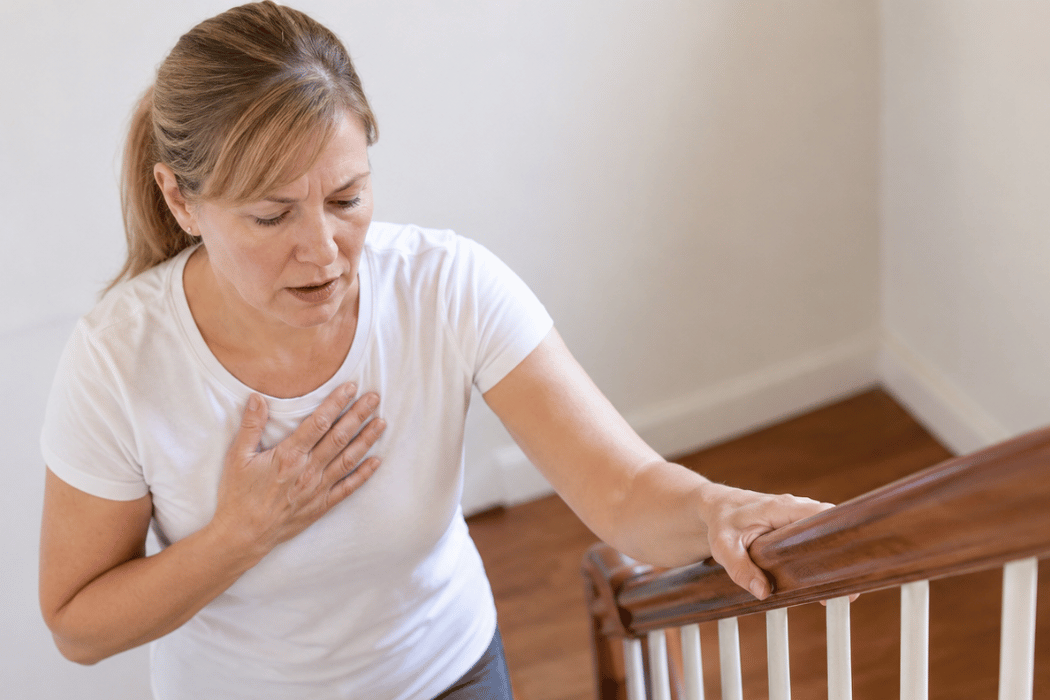

You used to take the stairs without thinking about them. Now you notice them. You reach the top breathing harder than the climb seems to deserve, and you wait a second at the landing before you say anything, so the person beside you does not hear it.
Maybe it is the stairs. Maybe it is carrying groceries in from the car, or getting through a whole sentence without a small catch of breath in the middle of it. Somewhere along the way you started leaving a little margin around ordinary things, and you did not announce it to anyone. You just quietly stopped doing a few of them.
You did the responsible thing about it. You mentioned it to your doctor. You may have had your heart checked, your lungs listened to, your blood drawn. And the results came back, and everything was, in the word everyone uses, normal. You walked out with a clean report and the same short breath you walked in with. If you have ever wondered why no one along the way mentioned any of what follows, we wrote about that separately.
So you did what a reasonable person does with a problem no one can name. You decided it was age. You decided it was you. You concluded, more or less, that this is simply how you breathe now.
We want to suggest something that sounds wrong at first
When you feel out of air, you are very often not actually short on oxygen.
That is a strange sentence to read when you are the one doing the gasping at the top of the stairs. Stay with us for a moment, because the reason is genuinely useful, and almost nobody explains it.
The feeling we all call needing air is not, for the most part, your body running low on oxygen. It is your body reacting to a rise in carbon dioxide, the gas you breathe out. Your body watches its level very closely, and when it climbs, an alarm goes off. That alarm is the urge to breathe. Oxygen barely enters into it until levels fall much further than they do in everyday life. This is ordinary respiratory physiology, and it is not controversial.
Here is the part that matters for you. That alarm has a threshold, and the threshold can drift. If a person breathes a little too much, day after day, often through the mouth and often a bit fast, the body gets used to carbon dioxide sitting low. The alarm becomes touchy. It starts going off at the faintest rise, long before there is any real shortage of anything.
Think of a smoke alarm set far too sensitive, the kind that shrieks when you make toast. Nothing is on fire. The toast is fine. The alarm is simply reacting to a wisp it should have ignored. Breathlessness during ordinary effort can work the same way. The signal is loud. The thing it is warning about is not there yet.
None of this means the feeling is imaginary. It is real, and you are not inventing it. It means the feeling may be a setting rather than a shortage, and settings can change.
Carbon dioxide is not the enemy you think it is
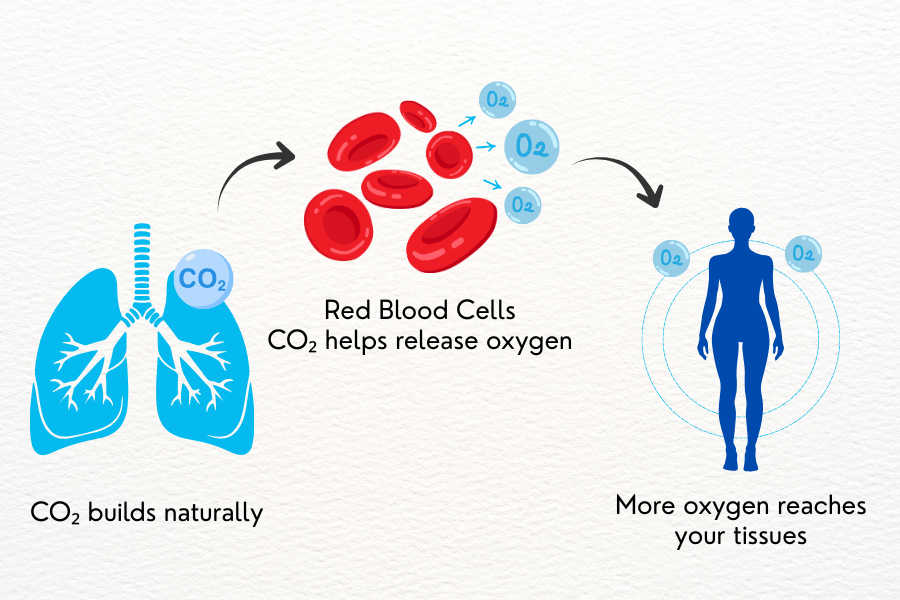
There is a second, almost hopeful piece to this. Carbon dioxide is not merely waste to be dumped as fast as possible. Your body uses it. Red blood cells release their oxygen more readily where carbon dioxide is present, a piece of chemistry described more than a century ago and named the Bohr effect. So carbon dioxide, in the right amount, is not the opponent of good oxygen delivery. It is part of how oxygen delivery works. A body that panics at the smallest rise of it is not protecting you. It is just out of practice.
What you do about a touchy alarm
You do not attack it. You gently, patiently teach it that a little carbon dioxide is safe, until the threshold settles back toward where it belongs. That is a large part of what breathing training is, and it is one reason every session at our studio includes coaching from the Oxygen Advantage program, taught by a certified instructor.
A lot of it is quieter and slower than you would expect. Some of it starts with something as simple as breathing through your nose instead of your mouth, which does more than it sounds like it should. Your nose adds nitric oxide to the air on its way in. That is a gas your own sinuses make, and it helps open the airways in your lungs, which is a large part of why nose breathing beats mouth breathing. James Nestor spends a good deal of his book Breathe on exactly this. The training builds from there.
We should be honest about what this is and is not. It is training, not a quick fix, and it is not a substitute for the care of your doctor. The work on breathing efficiency, meaning how well you use the air you already take in, is encouraging, and teachers like Patrick McKeown, who wrote The Oxygen Advantage, and Nestor have done a great deal to bring it into daylight. It is also an area where good people are still running the larger studies. We will not tell you it is settled. We will tell you the mechanism is sound and the practice is gentle, and let you judge the rest.
What a session actually looks like
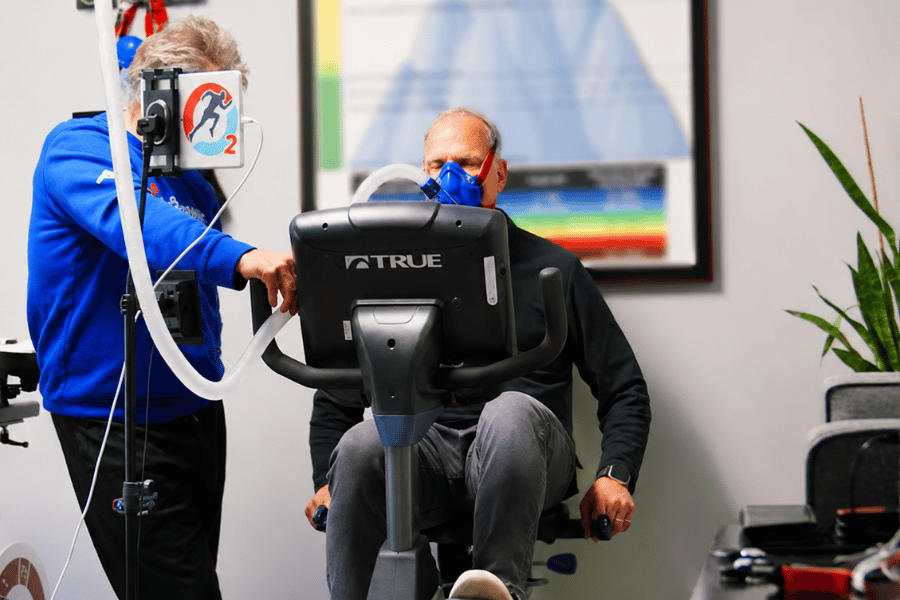
People often ask this with a little wariness, because the idea of having your oxygen managed sounds more intense than it is.
Here is the plain version of what happens in our studio in Watkinsville. You are guided the whole way through. Most people ride a stationary bike while they train, at an easy, conversational pace. There is a recumbent bike for anyone who prefers it or has balance concerns, and a chair for anyone who needs one. The movement is not incidental, and it is not strenuous. A little gentle effort is part of what makes the training work, because the effort is what creates the demand your body responds to. You are not lying still, and you are not pushing hard. You are somewhere easy in between, with someone talking you through each step.
One of our clients, a man in his seventies, put the feeling of it better than we could: “It’s easy to do. He talks you right through it. All you have to do is breathe.” We will add one honest footnote to his words, because we never want to mislead you. There is a little movement involved, gentle and guided. All you have to do is breathe is how it feels. It is not quite all you do. But it is close, and it is easy.
The breathing coaching sits alongside the core of what we do, which is IHHT, or intermittent hypoxic hyperoxic training. In plain terms, we gently lower the oxygen you breathe for a short while, then raise it well above normal, and repeat that a few times over about twenty to thirty minutes. The dip creates a demand, and your body answers it over time by building better machinery inside your cells. That machinery has a name. Mitochondria are the tiny engines inside each of your cells, the ones that take the oxygen you breathe and the food you eat and turn them into the energy that runs everything you do. More of them, and sturdier ones, is the adaptation the training is reaching for. We are the only certified IHHT and Oxygen Advantage facility in Georgia, a claim we are willing to stand behind precisely because it can be checked. But you do not need any of that to start breathing better. Some of the most useful changes begin with your nose and a little patience.
Frequently asked questions
Why do I get winded so easily when my tests come back normal?
Tests are good at ruling out many specific problems, which is exactly what a clean result does. Breathlessness during ordinary effort can be a matter of breathing efficiency and an over-sensitive response to carbon dioxide, rather than something a standard test is designed to flag. That is not a reason to skip medical care. If your doctor is still looking, keep working with them. It is a reason not to assume that normal results mean nothing can be done.
Does breathing more deeply help when I feel short of breath?
Often, counterintuitively, it does not. Breathing more, faster, and through the mouth tends to keep the carbon dioxide alarm touchy, which is the opposite of what you want. Slower, calmer, nose breathing usually helps more. One firm exception: sudden or severe shortness of breath is a medical matter, not a breathing exercise. If that happens, seek care.
Is this just a polite way of saying I’m out of shape?
No. Fitness is part of the picture, but breathing efficiency is a separate, trainable skill. Fit people can breathe inefficiently, and people who are not especially fit can breathe well. You can improve the breathing on its own.
Can I practice any of this at home?
Yes, gently. Breathing through your nose and slowing your breathing down are safe to explore on your own. Two cautions, and they are not negotiable: never perform breath holds in or near water, and never breathe heavily on purpose to hold your breath longer, because that can be genuinely dangerous. The more structured work is safer with coaching.
What actually happens in a session?
You are guided throughout. Most people ride a stationary bike at an easy pace, with a recumbent bike or a chair available. There is breathing coaching, gentle and short, over about twenty to thirty minutes.
Where are you located?
We are at 1021 Jamestown Blvd, Suite 215, Watkinsville, GA 30677. We serve Athens and the surrounding area, and we are the only certified IHHT and Oxygen Advantage facility in Georgia.
A calm first look, no pressure
If any of this sounds like your last few years, you are welcome to come and see it for yourself, with no sales pitch attached. You will find us at 1021 Jamestown Blvd, Suite 215, in Watkinsville, serving Athens and the surrounding area, and the first conversation is mostly us listening and explaining the science plainly. No pressure, just a clear look at what happens when you breathe, and whether training it might help.
If you came to this curious about performance and training rather than everyday breathlessness, there is a companion piece for you.
Breathe Better. Live Better.